
The Immigration and Customs Enforcement Agency (ICE) was originally founded in 2003 by President George W. Bush with the Homeland Security Act of 2002 following the 9/11 terrorist attacks. Formed by the merger of the U.S. Customs Service and the Immigration and Naturalization Service that handled border security and internal safety beforehand, ICE is the principal investigative arm of the U.S. Department of
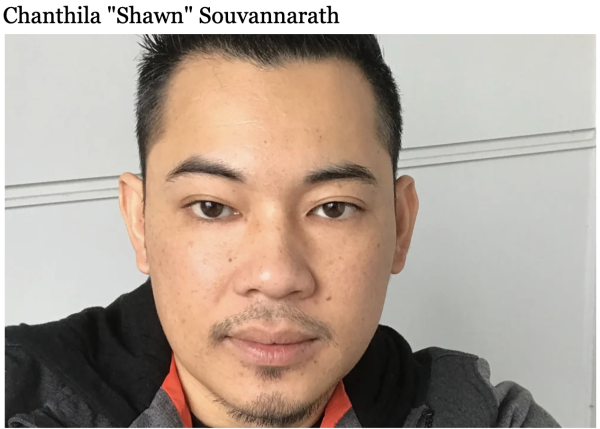 Homeland Security (DHS) and the second largest investigative agency in the federal government. Its primary responsibility is the identification and elimination of border, economic, transportation, and infrastructure security vulnerabilities. For the past 23 years, ICE had not undergone significant changes, that is, until the Big Budget Act of 2025. This Budget Act completely revamped the hiring process, scale, and goals of ICE. The Big Budget Act added 170 billion dollars to immigration to border and interior enforcement, and 75 billion dollars to the ICE budget over four years. This budget came with an expectation that ICE would deport 1 million people each year. This specific quota that every ICE agent has to work towards has led to some people being deported unnecessarily. This has led to some critics suggesting that the main purpose of ICE now is to meet these quotos rather than protecting the American people. Chanthila Souvannarath, who had citizenship for over 20 years, was one of the many victims of this quota. Despite having a federal court ruling that recognized his substantial claim to citizenship and prohibited his removal, ICE disregarded the orders and Mr. Souvannarath was deported to Laos. Mr. Souvannarath’s case is just one of many that show the inherent failures with the new system governing ICE. These issues mayalso stem from the hiring spree ICE underwent in 2025, fueled by its bigger budget and the demand to meet higher quotas. In just one year, the agency says it has “more than doubled [their] officers and agents from 10,000 to 22,000.” This increase in agents, along with the increased quota of deportations, forced ICE to change their training regiments. Most crucially, ICE lowered the training time from 13 weeks to only six weeks, which is now drastically less than the average US police time of 21 weeks. Some current and former ICE agents have not been satisfied with the state of the new training protocols, specifically, in how it cuts down on the available time to learn complex immigration law. A current ICE agent said, “You can’t train someone to do all the basic law enforcement stuff, let alone the law. Immigration law used to be a five or six-month course at the academy. How do you know that people are here legally unless you know the law? You use Google?” A former ICE agent said that this change in training could lead to a domino effect as more senior ICE agents plan for retirement, and new recruits, who didn’t have as much legal and enforcement training as previous generations, fill the gap.
This change in strategy, goals, hiring, and training is not just ornamental; it has concrete negative consequences in our world today. This is most easily seen in the tragedy surrounding the fatal shootings of Renee Good and Alex Pretti in Minneapolis.
 On January 7, 2026, Renee Good, a 37 year old US citizen, was killed by an ICE agent. Earlier that day, federal law enforcement officers in Minneapolis were “doing an enforcement operation” when their vehicle got stuck in the snow. Homeland Security Secretary Kristi Noem claimed that agents called for others to help remove the vehicle from the snow, when protesters arrived and were “preventing them from leaving the scene.” As this protest was happening, Good’s car was stopped diagonally on Portland Avenue while at least four cars passed perpendicularly, as seen in video footage recorded by Reini-Grandell. She was not a planned member of the mass protest at the time. She was merely stopping as her wife was jeering at the agents. At this point, Good was somewhat blocking the flow of traffic. Then, ICE Agents came to confront her. Eyewitness reports claim agents were heard giving Good conflicting orders, one telling her to leave at once, while the other said to get out of the car. One eyewitness, Emily Heller, said “The ICE agents got out of their vehicles and were screaming at her to ‘move, move, move’.” Then, many events happened nearly simultaneously. Good switched the car into reverse and went back a few feet. Good’s partner, Becca Good, tried to open the car door, and, despite training prohibiting such behavior, ICE Agent Jonathan Ross moved in front of Good’s vehicle (specifically on the front left side). Then, Good drove the car to the right, away from the ICE agent Jonathan Ross, and into the correct direction of traffic. Jonathan Ross fired the first shot through the front windshield toward Good at 9:37:13 a.m., according to ABC News’ metadata analysis. Jonathan Ross fired the second and third shot through the driver’s side window. Jonathan Ross was heard saying the words “F***ing b**ch.” A couple minutes later, when a bystander physician asked to check if there was a pulse asking, “Can I check a pulse?” An agent replied, “No, back up now!” The bystander said, “I’m a physician!” An agent replied, “I don’t care.” Another agent said EMS was on the way, and another said they had their own medics on scene. A woman asked, “Where are they?” but received no answer. The New York Times reported in their analysis of a video of the incident that after the shooting that “several agents, including the agent who opened fire (Jonathan Ross), [got] in their vehicles and [drove] off, apparently altering the active crime scene”
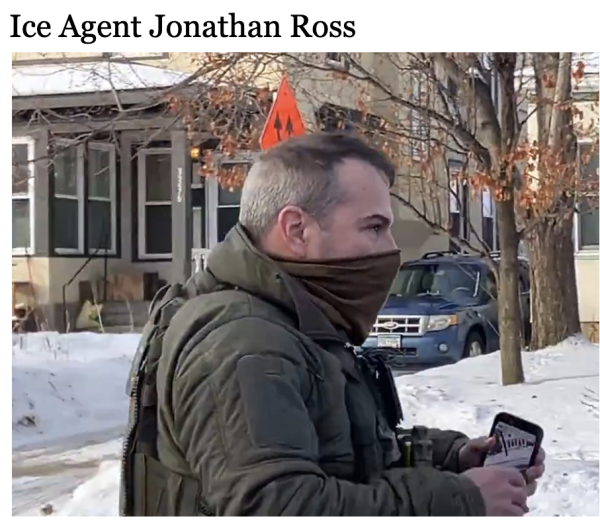 This tragic and violent incident is an example of the failings of the new ICE management system. Past ICE agents with experience have renounced the actions of Jonathan Ross. Both a current ICE agent and a former ICE agent with 25 years of immigration enforcement experience said, “If you fear for your life and you’re in imminent danger, policy says you could fire at that vehicle if there’s no other recourse,” and “If someone is able to make the argument that she was trying to hit him, he feared for his life, and all he could do was shoot…then sure, he can justify it that way.
But I think when you look at it a little bit more, it’s … very problematic for him.” Unfortunately, thi former agent had to say this anonymously because ICE prohibits current and past agents speaking on record on their behalf. This is also an example of the issues with the deployment of ICE agents to certain incidents. Both the former agent and the current agent also questioned why Ross was assigned to this operation in the first place, given a previous injury involving a driver at the wheel of a vehicle just a few months before the confrontation with Good. In this incident, he was left injured after being dragged 100 yards by a suspect fleeing in a vehicle. This was also after an impromptu traffic stop like the one in Good’s incident. These ICE Agents surmised that being put in a stressful situation, like the one in the past, might have caused him to act more irrationally rather than following training protocol.
This tragic and violent incident is an example of the failings of the new ICE management system. Past ICE agents with experience have renounced the actions of Jonathan Ross. Both a current ICE agent and a former ICE agent with 25 years of immigration enforcement experience said, “If you fear for your life and you’re in imminent danger, policy says you could fire at that vehicle if there’s no other recourse,” and “If someone is able to make the argument that she was trying to hit him, he feared for his life, and all he could do was shoot…then sure, he can justify it that way.
But I think when you look at it a little bit more, it’s … very problematic for him.” Unfortunately, thi former agent had to say this anonymously because ICE prohibits current and past agents speaking on record on their behalf. This is also an example of the issues with the deployment of ICE agents to certain incidents. Both the former agent and the current agent also questioned why Ross was assigned to this operation in the first place, given a previous injury involving a driver at the wheel of a vehicle just a few months before the confrontation with Good. In this incident, he was left injured after being dragged 100 yards by a suspect fleeing in a vehicle. This was also after an impromptu traffic stop like the one in Good’s incident. These ICE Agents surmised that being put in a stressful situation, like the one in the past, might have caused him to act more irrationally rather than following training protocol.
 Unfortunately, Renee Good’s death isn’t the only example of ICE’s new plan resulting in horrific and unjustified killings. Another tragedy only days later is that of Alex Pretti’s death. Alex Pretti was a 37-year-old intensive care nurse who lived in the Lyndale neighborhood of Minneapolis. Pretti was hired in 2014 as a research assistant in the clinical research program at the Minneapolis Veterans Affairs Health Care System. Pretti participated in protests against the killing of Renée Good earlier in January 2026. This tragedy captured on video happened on January 24th 2026, when Alex Pretti was killed after trying to record an ICE agent mid deportation. It is important to note that, at the moment when Preti is shot, he was fully subdued, and at no moment throughout the entire encounter did he make any aggressive movements towards officers, nor did the officers ask Pretti if he had a permit for the gun he had securely holstered on his hip at the time. However, even if he did not, Pretti would only be guilty of a petty misdemeanor, punishable with a maximum fine of $25. This killing has been condemned by many groups, notably the National Rifle Association (NRA) and the Gun Owners of America (GOA), especially for how the Trump administration framed Pretti’s carrying of a firearm as justifying the shooting. The GOA issued a statement saying, “We condemn the untoward comments of US Attorney Bill Essayli. Federal agents are not highly likely to be legally justified in shooting concealed carry licensees who approach while lawfully carrying a firearm. The Second Amendment protects Americans’ right to bear arms while protesting—a right the federal government must not infringe upon.” This statement is meant to counteract the precedent set by ICE that if you use your legally acquired permit to open carry guns, you sign away your own life. This is not the law in any state.
The right to protest peacefully is one of the most important and sacred rights ensured by the United States Constitution. It should be protected and not destroyed or desecrated. It is a disgraceful failure to all who have died to protect our freedoms, that people are being executed for trying to utilize them.










Kyle Martin • Mar 13, 2026 at 10:58 AM
Obviously unresearched mid slop. Do better
DjDev • Mar 11, 2026 at 1:16 PM
Amazing informative article Kyle. Really shows us what is going on in the world.