
The Artemis II mission is the first majorly publicized US space mission since 2011. This mission grew famous for both its incredible crew, its place in popular culture, its scientific importance, and its use of new technologies and space innovations. The Artemis II mission is the second mission in the Artemis mission series, the spiritual successor to the Apollo mission series which first landed on the moon.
The overall goal of the Artemis II mission is to renew the US’s capability for lunar surface missions. Secondarily its goal is to establish long-term lunar science and exploration capabilities, as well as inspire the next generation of explorers. This mission will take astronauts on a nine day outbound mission that will tackle them around the dark side of the moon and more than 230,000 miles from earth. At their max distance, the crew will fly 4,600 miles beyond the Moon. During the approximate nine-day trip, the astronauts will continue to evaluate the spacecraft’s systems.
The previous Artemis I was an uncrewed moon orbiting mission that was launched in November 2022. As the first major spaceflight of NASA’s Artemis program, Artemis I marked the agency’s return to lunar exploration after the conclusion of the Apollo program five decades earlier. It was the first integrated flight test of the Orion spacecraft (not an entire spacecraft, just a module) and Space Launch System (SLS) rocket. NASA planned future Artemis missions as well. The Artemis III’s goal will be to test the rendezvous and docking capabilities of the Orion spacecraft with private commercial spacecraft. Orion, on top of NASA’s SLS (Space Launch System), will launch from Kennedy Space Center in Florida. Orion will go into low Earth orbit to rendezvous and dock with either, or, both Space X and Blue Origin landers, which are needed to land people on the moon. The theoretical Artemis IV mission is meant to astronaut travel into lunar orbit, in which two crew members will then descend to the surface of the moon’s south pole where they will conduct new science for approximately a week before the lander will then reenter lunar orbit, and rendezvous and dock with the Orion spacecraft that will take them back to Earth.
The Orion spacecraft is the space shuttle that will carry the members of the Artemis 2 mission and their various scientific equipment and experiments. The spacecraft is built by Lockheed Martin and its notable for containing radiation scanning equipment and panels, being able to carry 76,000lbs, having an integrated lab, and a launch abort system that if necessary is able to activate in milliseconds to pull the vehicle to safety and position the crew module for a safe landing. Another one of the spacecraft’s main improvements is its streamlined control scheme; electronic procedures are programmed into the system to aid the crew in daily and emergency processes, saving the crew time and space and making large paper manuals of system operations obsolete. The Orion spacecraft has been used and improved since the Artemis mission, this is just the current version of the craft that will be improved over time for later missions.
On the Orion Space Shuttle the members of the Artemis II mission crew will gather data for many crucial space studies that focus on how the human body reacts to such radically different conditions and how radiation affects the crew and their shuttle. On the 9 day trip the Artemis II crew gathered data for five different studies: Standard Health Studies, A Virtual Astronaut Tissue Analog Response (AVATAR), Immune Biomarkers, Artemis Research for Crew Health and Readiness (ARCHeR), and the use of radiation sensors inside and around the Orion spacecraft. These different studies will allow for future longer missions and will bring us closer to colonization. The Standard Health Studies purpose is to study how being in deep space affects astronaut biology. Blood samples will be collected before and after the mission, while urine and saliva samples will be collected during the mission. These samples will be used to provide researchers with insight into key physiological responses that will inform future protocols aimed at maintaining astronauts’ health. The AVATAR program focuses on studying the effect of radiation and microgravity on human cells. Organ chips (chips that contain cells derived from various organs of each Artemis astronaut) will be stored in controlled environments. The same organ for each person will be stored on a chip, so that scientists can compare and contrast between two chips (the one in space and another on earth) to see the effects space has on the human body. These organic chips also contain bone marrow. Since bone marrow is responsible for producing red blood cells, white blood cells, and platelets, studying bone marrow is ideal for diagnosing diseases and gauging how a person’s immune system responds to treatments. The ARCHeR study is one focused on the sleep schedule, well being, and activity of the Artemis II astronauts so that they will be able to launch Orion capsules further into space while keeping the astronauts safe. The goal of both this study and the future Orion capsule will be to better understand the effect deep space has on the human body so that NASA can develop protocols in order to allow future humans to survive and thrive for future moon and Mars missions. Immune biomarkers are measurable biological factors—such as proteins, cells, or genes—found in blood, saliva, or tissue that indicate immune system activity. NASA would get biomarkers by analyzing blood and saliva and they expect to understand how stress hormones, viruses, and cells may be affected by flight conditions. The overall goal is to learn how to counter the dangerous effects of spaceflight on the immune system (spaceflight can increase susceptibility to opportunistic pathogens and viral reactivation). Even if you’re scared of heights, this scientific research can help better understand humanity’s understanding of aging and cancer treatment. Finally, the Orion spacecraft has radiation sensors that will improve upon the information gathered in the Artemis I mission to better interpret the radiation studies done during the Artemis II mission (like in the AVATAR and ARCHeR studies.) For the Artemis II mission NASA partnered with German Space Agency DLR to update and improve upon the sensors from the Artemis I mission. The new version (the M42 – EXT) offers six times more resolution to distinguish between different types of energy, compared to the Artemis I version. The sensor data will paint a full picture of radiation exposures inside Orion and provide context for interpreting the results of the ARCHeR, AVATAR, Artemis II Standard Measures, and Immune Biomarkers experiments.
The Artemis II mission as I’m sure you already know has four crew members contained in the Orion spacecraft. The members of the mission are Reid Wiseman (NASA) , Victor Glover (NASA) , Christina Koch (NASA), and Jeremy Hansen (from CSA).
Reid Wiseman is a 27 year navy pilot Veteran who was selected as an astronaut by NASA in 2009 and served as Flight Engineer aboard the International Space Station for Expedition 41 from May through November of 2014. During the mission he and his crew performed over 300 experiments in fields such as: human physiology, medicine, physical science, Earth science and astrophysics. Reid Wiseman has a Bachelor of Science degree from Rensselaer Polytechnic Institute in Troy, New York, Master of Science in Systems Engineering from Johns Hopkins University, Baltimore, Maryland, 2006. Certificate of Space Systems, US Naval Postgraduate School, Monterey, California, 2008. At VX-23, Reid earned his Master’s degree and worked various flight test programs involving the F-35 Lightning II, F-18 weapons separation, Ship Suitability and the T-45 Goshawk. Since first being selected in ’09, Reid kept busy, completing his training in 2011 and serving as chief of the astronaut office from 2020-2022.
Chritina Koch has worked for the International Space Station for nearly all of 2019 in Expeditions 59, 60, and 61. She spent a total of 328 consecutive days in space and participated in the first all-female spacewalks. She served as Branch Chief of the Assigned Crew Branch in the Astronaut Office and did a rotation as Assistant for Technical Integration for the Center Director at NASA’s Johnson Space Center. Prior to becoming an astronaut, Christina’s experience spanned both space science mission instrument development and remote scientific field engineering in the Antarctic and Arctic. Christina attended North Carolina State University in Raleigh, North Carolina, where she earned Bachelor of Science degrees in electrical engineering and physics. She then also received a Master of Science degree in electrical engineering and studied abroad at the University of Ghana. She later received an Honorary PhD from North Carolina State University. Christina has been awarded the Neil Armstrong Award of Excellence, the Astronaut Scholarship Foundation, 2020; Astronautics Engineer Award, National Space Club & Foundation, 2020; Global ATHENA Leadership Award, ATHENA International, 2020. NASA Group Achievement Award, NASA Juno Mission Jupiter Energetic Particle Detector Instrument, 2012; Johns Hopkins University Applied Physics Laboratory, Invention of the Year nominee, 2009; United States Congress Antarctic Service Medal with Winter-Over distinction, 2005; NASA Group Achievement Award, NASA Suzaku Mission X-ray Spectrometer, 2005.
Victor J. Glover is the pilot of Orion Spacecraft, but this is far from his first rodeo. Glover is an experienced pilot who most recently served as the pilot of the Crew-1 Dragon spacecraft, named Resilience. Resilience flew to the International Space Station, where he also served as Flight Engineer for Expedition 64/65. He earned his Wings of Gold on December 14 2001, was a Navy captain, and was selected in 2013 as one of eight members of the 21st NASA astronaut class. Victor has been awarded with The Defense Superior Service Medal, Navy Commendation Medal, two Navy and Marine Corps Achievement Medals, NASA Distinguished Service Medal, and NASA Space Exploration Medal; Ontario High School 1994 athlete of the year; Cal Poly, San Luis Obispo, Service to the Community Award and community service notation on transcripts; Distinguished Graduate and Regimental Commander, U.S. Navy Officer Candidate School; Onizuka Prop Wash Award, United States Air Force Test Pilot School; Distinguished Graduate, Air Command and Staff College; Named one of Jet Magazine’s inaugural 40 under 40 in 2013; 2023 ASE Congress Perchatka; Member of 2023 TIME 100 Next.
Jeremy Hansen is the first Canadian to go to the moon. Jeremy Hansen holds a bachelor of science in space science (first class honours) from the Royal Military College of Canada in Kingston, Ontario (1999). He also earned a master of science in physics from the same institution in 2000, with a research focus on Wide Field of View Satellite Tracking. Some of his Special honors include: Air Cadet League of Canada Award – Top Air Force Graduate from the Royal Military College of Canada (May 1999), Clancy Scheldrup Memorial Trophy – Outstanding Graduate on the Basic Flying Course (2001), Canadian Air Force Pilot Wings (May 2002), Canadian Forces Decoration – 12 Years of Good Service (October 2006), The Queen Elizabeth II Diamond Jubilee Medal (2012), Gold Medal of the Royal Canadian Geographical Society (2014).
The saying goes that what comes up must come down. The Space Launch System (SLS) is a heavy rocket, and the only spacecraft that can bring supplies and crew to the lunar surface in a single mission. The two shuttle-derived solid rocket boosters provide more than 75% of the rocket’s thrust during the first two minutes of flight. Each modified booster is 177 ft. tall, 12 ft. in diameter, weighs 1.6 million lbs., and produces a maximum of 3.6 million lbs. of thrust during launch. The design also includes new avionics, propellant grain design, and case insulation, and eliminates the recovery parachutes to allow greater payload to orbit. The boosters have already been completed for the Artemis three missions. These boosters are tested at the Kennedy and Marshall space center. The ability to propel the Orion spacecraft out of orbit is due the interim cryogenic propulsion stage (ICPS) based on the Delta Cryogenic Second Stage used successfully on United Launch Alliance’s Delta IV family of rockets. The ICPS uses one RL10 engine made by L3Harris. The engine is powered by liquid hydrogen and liquid oxygen and generates 24,750 lbs. of thrust. There is a specific adapter between the Orion space shuttle and the SLS that allows for larger cargo to be carried into space. Soon the ICPS will be replaced by another, more efficient stage which is planned to have almost four times more thrust and will be used by the block 1b and later blocks. This new system is planned to be made by Boeing. SLS was created with the help of more than 1,100 companies from across the U.S. and at every NASA center supporting the development of the Americas newest rocket. As many know, a major goal of a space mission is making sure the astronauts come down alive on the planet they are landing on. The Human Landing System (HLS) is a mode of transportation that will take astronauts down to the lunar surface, where they will conduct experiments, take samples, and observe the lunar environment before the HLS returns them to Lunar Orbit, where they will rendezvous and dock with the Orion spacecraft. NASA is focused on establishing landing sites along the lunar south pole, a permanent lunar base on the surface of the moon, and increasing the duration of surface expeditions. The HLS is required to have docking capabilities with multiple systems, to land within range of lunar geographical regions, and to act as a lunar habitat on the surface of the moon for early missions. NASA is working with American industry to develop the lunar landers for Artemis. NASA is mainly sharing its information and maintaining safety oversight, while companies develop and test the landers. NASA currently has a contract with Space X of Hawthorne, California, for its Starship HLS that will be the first HLS to put first Artemis astronauts on the moon. NASA and Space X are currently working together to make sure that the Starship HLS’s design meets all of the safety and mission requirements. Space X will perform one uncrewed demonstration mission during Artemis III, to see if their system is compatible with docking to the Orion Spacecraft. NASA is working with multiple HLS providers, to ensure that Moon landing missions become much more routine. The hope is that NASA working with multiple HLS providers will incite competition, reduce taxpayer costs, and further invest in the lunar exploration economy. NASA has contracts with both Space X and Blue Origin, who are meant to develop HLS that are able to allow for increased crew sizes and bring a larger amount of mass to the surface of the moon. NASA wishes to maintain continuous missions to the lunar surface. To ensure this, they have partnered with five companies to reduce the risk in development of HLS, and learn how to best develop them. These five companies are: Blue Origin, Kent, Washington, Dynetics, Huntsville, Alabama, Lockheed Martin, Littleton, Colorado, Northrop Grumman, Dulles, Virginia, and Space X, Hawthorne, California.
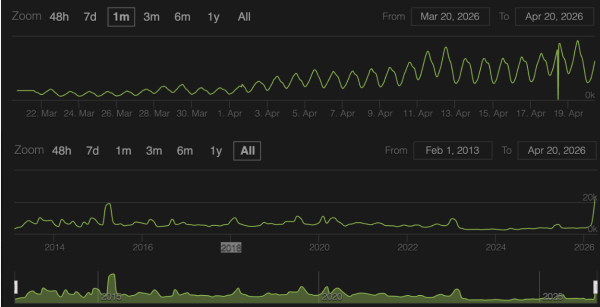
The Artemis II mission has reframed and inflamed America’s passion for the exploration of deep space. The Artemis II mission has started a slew of tiktok edits ( Here are two examples: Edit 1 and Edit 2) and also grew its popularity through people jokingly comparing the astronauts to members of the Fantastic Four. A fun chart to see this renewed love of space is the growth of old rocketship building and launching game Kerbal Space Program.
Here is an example of the steam charts of the player country growing from when it first launched in 2013 to today and over the past month. The Artemis II space mission is another crucial step forward for the culture of the United States.














Kyle Martin • May 20, 2026 at 1:33 PM
Did you know that the Artemis Space Launch was super cool?
Human Being • May 20, 2026 at 1:34 PM
Did you know that I agree with that? Also did you know that the references are insane.